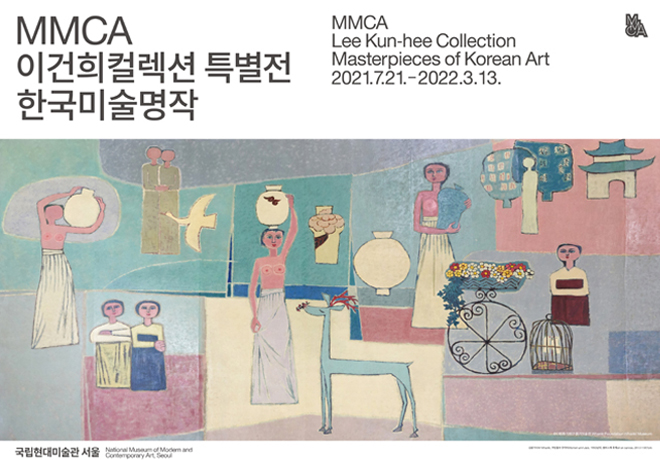
※ All images of the MMCA collection appearing on this MMCA website are protected by copyright under the Copyright Act. You may not copy, transmit, distribute, or in any way commercially exploit such content without prior written permission of the copyright holder identified in the individual content’s copyright notice.
Kim Whanki (pen name Suhwa, 1913–1974) was a pioneer of abstract painting in Korea. He went to Japan, and submitted his works to Nikaten (二科展), one of the most authoritative groups at that time, and the Free Artists Association Exhibition (自由美術家協会展), an abstract art group. He graduated from the Department of Fine Arts in Nihon University (日本大学), Tokyo, in 1936, and returned to Korea in 1937. In Korea, he formed a modernism art group called the Neo-Realist Group (新事實派) with Yoo Youngkuk (1916–2002) and Lee Gyusang (1918–1964). At this time, he constructed his own style by simplifying and stylizing the traditional Korean objects and landscapes, including porcelain, the moon, deer, and mountains. From 1956, he spent his time in Paris, and returned home in 1959. In 1963, he participated in the São Paulo Biennale, and then went on to New York. In New York, he changed his artistic style. His concrete motifs disappeared, and his works were composed of dots and lines, becoming known as Kim’s “dot paintings.”
This work painted in Kim’s New York Period (1963–1974) is full of navy blue dots, which seem to express the night view of the city or stars in the night sky. The dots, making uniform color blocks, seem to share characteristics with Where, What Have We Become and Met Again (1970), which was awarded the Grand prize at the first Korea Arts Exhibition sponsored by the Hankook Ilbo in 1970. Compared with Kim’s works of the 1970s, the size of the dots is bigger, and their arrangement is looser, which is the early style of his all-over dot paintings.