본문으로 바로가기

MMCA Collection: Korean Modern and Contemporary Art II

  • 2026-04-22 ~ 2027-06-27
  • Gwacheon 2F, Gallery3, 4

Exhibition Overview

MMCA Collection: Korean Modern and Contemporary Art II
KIM Whanki, ‹Dawn #3›, 1964-1965, Oil paint on canvas, 176.9×109.6cm
PARK Seobo, ‹Primordials No.1-62›, 1962, Oil paint on canvas, 163×131cm
SUH Seungwon, ‹Simultaneity 67-1›, 1967, Oil paint on canvas, 160.5×131cm
YUN Hyongkeun, ‹Umber Blue 82-86-32›, 1982-1986, Oil paint on canvas, 189×300cm
RHEE Seundja, ‹Path to the End of the Earth  November 1983(Chemin des antipodes Novembre 83)›, 1983, Acrylic paint on canvas, 129×194.5cm
RHEE Seundja, ‹Path to the End of the Earth November 1983(Chemin des antipodes Novembre 83)›, 1983, Acrylic paint on canvas, 129×194.5cm
CHOI Wook-kyung, ‹Joy›, 1977, Acrylic paint on canvas, 227×456cm
OH Yoon, ‹No Sowing in the Spring, No Harvesting in the Fall›, 1985, Linoleum cut on fabric, 67.8×49.5cm
YUN Suknam, ‹Mother 2-Daughter and Son›, 1992, Acrylic paint and pastel on wood, photocopy on paper, 170×180cm
PARK Rehyun, ‹Work›, early 1970s, Yarn, sink strainers, tapestry, 131×129

The permanent exhibition MMCA Collection: Korean Modern and Contemporary Art II at MMCA Gwacheon presents over 120 significant works from the museum’s collection, produced during the latter half of the 20th century. The MMCA’s inaugural location opened within Gyeongbokgung Palace on 1969, with the 18th National Art Exhibition as its opening exhibition and the systematic organization of this annual exhibition as one of its foundational objectives. The collection of artworks began in 1971, and over the past five decades, the museum has built a collection of more than 11,800 works and archival materials, with a continued focus on the acquisition, conservation, and scholarly study of artworks that reflect the history of Korean art.


Drawing from key holdings in the collection, this exhibition offers a comprehensive overview of Korean art from the late 1950s to the late 1990s, situating major works and artists within discourses pivotal to understanding Korean modern and contemporary art such as figuration and abstraction, tradition and modernity, institutional convention and avant‒garde experimentation, and aesthetic autonomy and social engagement. Thematic sections such as “The Establishment of Government and the National Art Exhibition” and “Modernist Women Artists” foreground narratives and figures that have often been marginalized in style‒or movement‒centered art histories, while sections dedicated to seminal artists such as Kim Whanki (1913–1974) and Yun Hyong‒keun (1928–2007) offer an immersive understanding of each artist’s distinct body of work.


On Wednesday, April 22, the MMCA Gwacheon will unveil a newly curated, Korean Modern and Contemporary Art II have been partially reconfigured to include a broader range of artists and works, deepening the multi-layered perspective on Korean art history they provide. Section 5, Modernist Women Artists, highlights previously marginalized figures through textile works, including Park Rehyun’s Work(early 1970s), and newly presented pieces such as Jeong Jeonghee’s Power(1984) and Lee Kisoon’s A Beach in Yugoslavia(1982). Section 10, The Return of Figuration and the Reflection of Reality, presents works by Oh Yoon, Jeong Jeongyeob, and Yun Suknam, alongside Ko Younghoon’s sculptural work Stone Book (1987), shown for the first time, reflecting trends in Minjung Art, feminist art, and hyperrealism.


Korean modern and contemporary art took shape amid the upheavals of Japanese colonial rule, the Korean War, industrialization, and democratization through the practices of artists attuned to these shifting realities. This exhibition revisits the ideas that sustained creative production throughout the decades, observing formal achievements made along the way from a stereoscopic perspective. In doing so, they invite viewers to explore the historical trajectories and future possibilities of Korean art as part of a continuous lineage extending into the present.

  • Artist
    Approximately 78 artists including Kim Whanki, Min Joungki, Park Saengkwang, Park Seo-Bo, Suh Seok, Suh Seungwon, Yoo Youngkuk, Yun Hyong-keun, Rhee Seundja, Lee Sookja, and Choi Wook-kyung
  • Numbers of artworks
    Approximately 109 artworks

Audio Guide

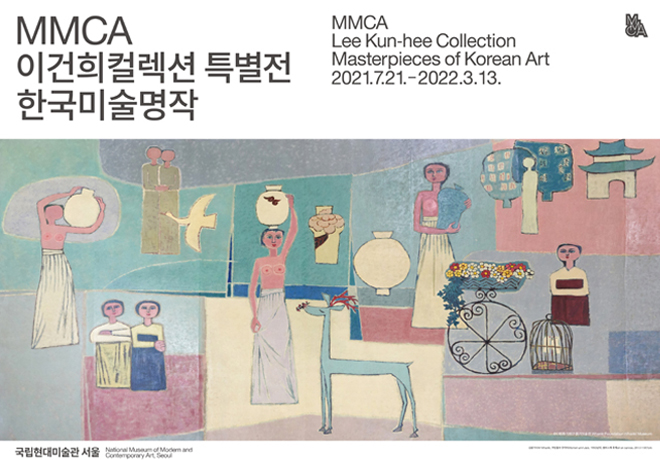
1. Introduction Welcome to MMCA Gwacheon. ‹MMCA Collection: Korean Modern and Contemporary Art II›, a sequel to ‹MMCA Collection: Korean Modern and Contemporary Art I› presented on the third floor, is a permanent exhibition tracing the diverse developments in Korean art from the late 1950s to the late 1990s through key works in the MMCA Collection. Since acquiring its first 12 works in 1971, the MMCA has steadily expanded its holdings over the past five decades, collecting and studying artworks of both historical significance and contemporary relevance. In particular, the 2021 donation of the Lee Kun-hee Collection consisting of 1,488 works has brought the museum’s collection to approximately 11,800 pieces, further enriching its scope. This exhibition draws on these accumulated holdings to present a multifaceted view of Korean modern and contemporary art. With thematic sections such as “The Establishment of Government and the National Art Exhibition,” “Between Figuration and Abstraction,” and “Modernist Women Artists,” it revisits lesser-known practices often omitted from dominant art historical narratives. Special sections dedicated to artists such as Kim Whanki and Yun Hyong-keun also offer an immersive encounter with their artistic worlds. Through the works of artists symbolic of Korean modern and contemporary art, this exhibition offers multidimensional reflections on and interpretations of how Korean art has evolved through the country’s tumultuous modern history.
Introduction

1.Introduction