The Modern and Contemporary Korean Calligraphy exhibition aims to explore the role and significance of calligraphy in Korean modern and contemporary art. Originally showcased at Deoksugung in Seoul in 2020, the exhibition, systematically introduced the development and transformation of Korean calligraphy in the modern era. Recognizing the lack of comprehensive exhibitions on Korean calligraphy in Taiwan, the Taoyuan Museum of Fine Arts has partnered with the National Museum of Modern and Contemporary Art, Korea, to debut significant Korean calligraphy works at the Hengshan Calligraphy Art Center. We hope to present diverse perspectives of calligraphy and initiate dialogues about its place in East Asian modern and contemporary art.
In East Asia, 書(서, writing or calligraphy) is referred to as 書法(shufa) in modern Chinese, and 書道 (shodo) in Japan. In Korea, it was referred to as 書 or 서 (seo) until the period of Japanese colonial rule when it became known as서도(seodo), similar to Japanese shodo. Upon Korea’s liberation in 1945, there was a proposal by Son Jae-hyeong (1903-1981) , also known as Sojeon, to use the term서예(Seoye, 書藝) instead of the Japanese term서도 (seodo), leading to the widespread adoption of the term 서예 (Seoye) in Korea. Since then, with calligraphy occupying a field within the realm of art, especially during the early years of the National Art Exhibition (대한민국미술전람회, 1949-1981), 서예 (Seoye) has progressively evolved into a full-fledged “art” form.
After the liberation, Korean painters began to pay attention to calligraphy as a means to revive national art and create a Korean form of modernism. Calligraphers, too, earnestly deliberated on producing calligraphy imbued with a new sense of modernity distinct from the traditional era. More recently, with calligraphy being diversified as a tool in design, calligraphy, known as 캘리그라피 in Korean, and typography, known as 타이포그라피, are opening up new possibilities for the expansion of calligraphy.
1. “The Person in the Script,” focuses on the work of 10 first-generation Korean modern and contemporary calligraphers to explore how traditional calligraphy culture and styles transformed in the modern era. Most of these artists, such as Son Jae-hyeong and Hyeon Junghwa, were adept in the five calligraphy styles: seal script, official script, block script, semi-cursive script, and cursive script. Leading the way in the modernization of calligraphy amid the turbulent period of the Japanese occupation and Korea’s subsequent liberation, they established their own artistic visions. Through works revealing calligraphic expressions of the artists’ unique strengths and reflections of their lives and temperaments, this section demonstrates that the writing truly was the person.
The Person in the Script
|
|
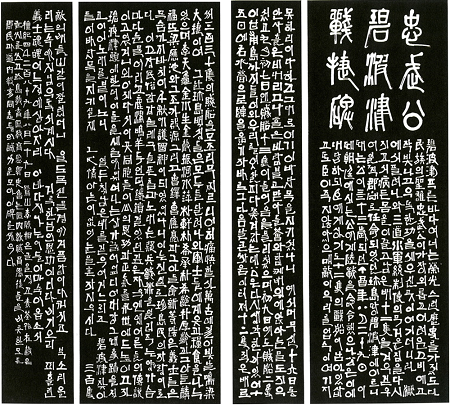
Son Jae-hyeong, A Rubbing of the Stele Commemorating Admiral Yi Sun-sin's Victory at Byeokpajin Ferry, 1956, DongSung Gallery collection
|
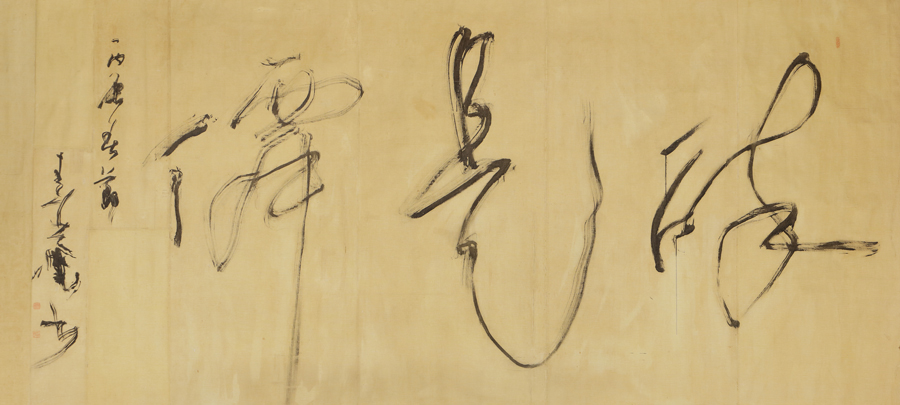
Hyeon Junghwa, When Drunk, I Become a Daoist Hermit, 1976, The Soam Memorial Museum collection
|
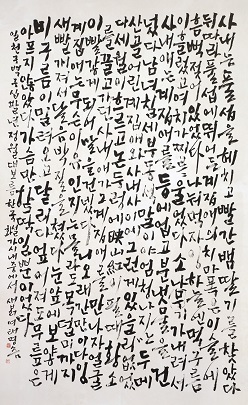
2. “Revisiting Calligraphy,” focuses on post-World War II creations by calligraphers educated by members of the first National Art Exhibition generation. By examining their novel creations and experiments in contemporary calligraphy, it raises questions about calligraphy’s expansive potential and artistry within contemporary circles. At this time, the medium underwent its first diversification and individuation through figures such as Kwon Chang-ryun, Park Won-gyu, and Hwang Sukbong. Where traditional calligraphy had been grounded in unity between text and script, contemporary calligraphy focused more on calligraphic images than on textual content or readability, emphasizing that it was meant to be viewed as opposed to read. This section presents examples of calligraphy as fine art, connecting and converging with other genres as it reflects currents observed in contemporary art.
Revisiting Calligraphy
|
|
Hwang Sukbong, Horses, 1991, private collection
|
Yeo Tae-myong, Gasinae (Girl), 1998, private collection
|
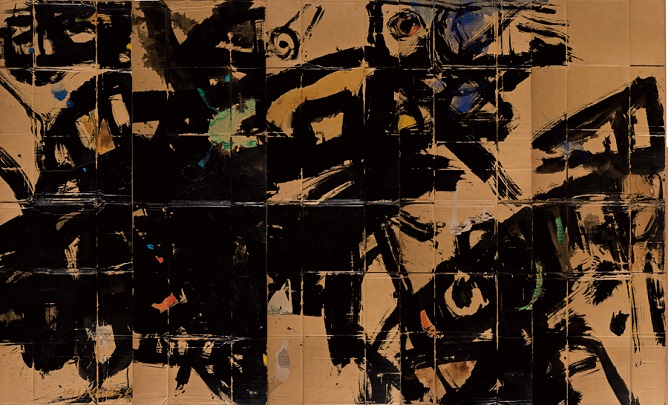
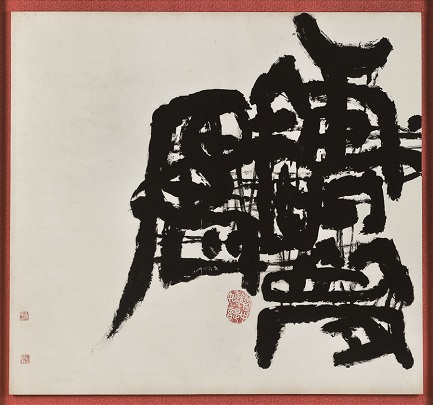
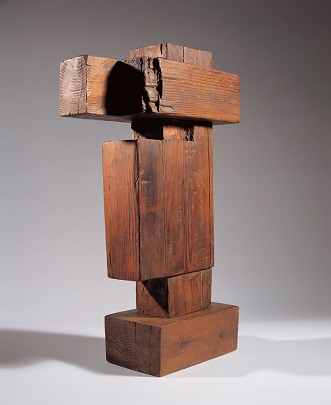
3. “Drawing Calligraphy, Writing Painting,” examines the influence of calligraphy on other genres such as painting and sculpture to justify the examination of calligraphy in the context of art museums and its identity as another art form. This section further divided into the two subtopics of “character abstraction” and “calligraphy abstraction” for a comprehensive look at the relationship between contemporary art and calligraphy through the work of figures such as Lee Ufan and Lee Kang So. “Character abstraction” examines the ways in which character elements constructed through calligraphy’s structures and composition were expressed in individual canvases. “Calligraphy abstraction” considers how works expressed and reflected characteristics such as the line quality associated with the calligrapher’s brush, along with its sustained tempo, rhythm, and energy.
Drawing Calligraphy, Writing Painting
|
|
Kim Ki-chang, Pictorial Ideograph, 1980, Daejeon Museum of Art collection
|
Kim Chong Yung, Work 65-2, 1965, Kim Chong Yung Museum collection
|
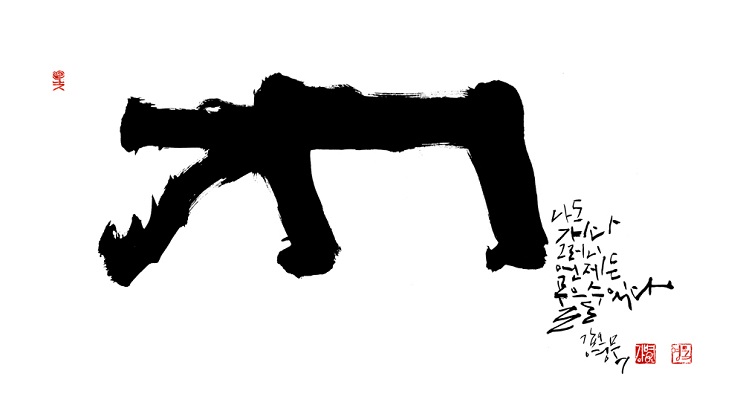
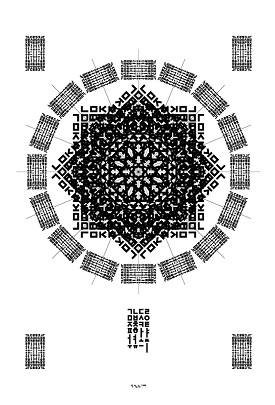
4. “Infusing Daily Life with Design,” uses the works of artists such as Kim Zhongkun and Lee Sang-hyun to reveal a range of possibilities for calligraphy’s expansion through the application of design aspects, while also focusing on calligraphy culture as part of daily life and the written character as part of contemporary society. Elements of both practicality and artistry are present in the use of calligraphy, a medium based on the hand-written character expanding into the emotional realm of visual art, and typography, characters typically designed to be more readable or aesthetically pleasing.
Infusing Daily Life with Design
|
|
Gang Byung-in, Dog, 2014, private collection
|
Ahn Sang-soo, Hangeul Mandala, 1988, private collection
|